
June 2026 Pennsylvania Benefits Review
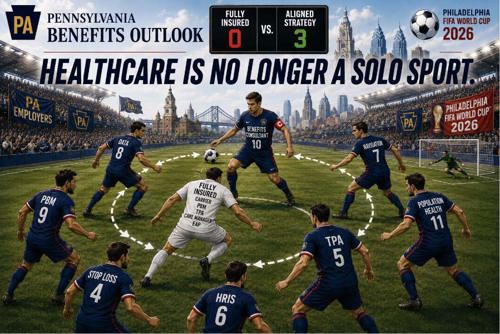
"World Cup Confirms: Healthcare Is No Longer A Solo Sport"

brad.anderson@fcfins.com
(412) 770-5318
Opening Thought
The title of this month’s inaugural publication draws from the FIFA men’s World Cup 2026, kicking off in Philadelphia and throughout the United States, Canada and Mexico. With over 30 years of experience as a player, coach and referee, I’ve always appreciated that while star players grab the headlines, championships are won through team coordination, communication and execution.
We’re seeing a similar lesson play out in Pennsylvania’s employer healthcare market.
What We're Seeing
Across Pennsylvania, employers are facing increasingly complex healthcare challenges that no single carrier, PBM, TPA or vendor can solve alone. Much like today’s elite soccer legends, Messi and Ronaldo, they can’t succeed without a coordinated team.
Healthcare costs continue to be influenced by specialty medications, complex medical conditions, GLP-1 utilization and behavioral health needs. At the same time, many communities are experiencing provider shortages, hospital consolidation and growing concerns around access to care.
As a result, employers are increasingly evaluating not just the performance of individual vendors, but how their healthcare partners work together. The conversation is shifting from managing a collection of vendors to building a coordinated healthcare strategy supported by data, accountability and aligned objectives.
So What: Why It Matters To Employers
Pennsylvania employers are discovering the greatest risk to their health plan is no longer broad trend but volatility. One or two catastrophic claims, specialty drug cases or complex medical conditions can significantly impact plan performance. At the same time, access to quality care and employee navigation challenges can affect outcomes, productivity and workforce satisfaction.
Strong individual vendors remain important. However, even highly capable partners can produce inconsistent results when they operate independently rather than as part of a coordinated strategy.
What We're Watching
Several interconnected trends continue to shape the conversation for Pennsylvania employers:
- Increases in specialty pharmacy consumption, GLP-1 utilization and catastrophic claims volatility
- Decreased access to rural healthcare, continued provider consolidation and when to leverage Direct Primary Care
- Competition for workforce attraction and retention through unique population health incentives
While these challenges vary by employer, they reinforce a common theme: organizations with greater visibility into their data and stronger alignment among their healthcare partners are often better positioned to make informed decisions.
Now What: What We Recommend
Start by evaluating your healthcare team, not just your healthcare vendors. Ask:
- Are our partners working toward the same goals with access to meaningful data and actionable insight?
- Who is responsible for coordinating and executing the strategy?
- Are we proactively managing risk or simply reacting to renewal results?
The right benefits consultant can play an important role in bringing these pieces together by helping align partners, interpret data and maintain accountability across the healthcare ecosystem. As healthcare grows more complex, employers increasingly benefit from having an experienced advisor who can help coordinate strategy and drive results.
Healthcare Is No Longer a Solo Sport:
A World Cup team doesn’t succeed because of one player. It succeeds because different positions execute a common game plan.
Pennsylvania employers are facing a similar reality. The advantage is no longer having the best individual vendor. The advantage is having the best-coordinated team.